Alma Serum – where Environmental science and Biotech innovation converge with the Beauty industry
First of a series of case-studies on innovative SMEs and start-ups in Life Sciences in Europe. Alma Serum is an early stage innovative startup in the cosmeceutical and clean beauty field. The main products are innovative absorbable face masks delivering bioactive ingredients to the deeper levels of the skin with an anti-aging and skin healing effect - all done in an eco-friendly, sustainable and regenerative way, using agri-food waste compounds and an innovative patented hardware device. The team of four has many decades of experience among them, strong technical and business expertise and in just one year of life, Alma Serum have received several awards for their innovation.
CASE-STUDYCOSMECEUTICALSSTARTUPSHEALTHCARE INNOVATIONSKINCAREBUSINESS INNOVATIONLONGEVITY
Irene Petre
7/21/20269 min read
Company and team overview
Alma Serum is an Italian deep-tech biotechnology platform redefining active compound delivery for the Beauty, Clinical Skincare and Pharmaceutical industries – the startup was founded just a year ago, in June 2025. It operates out of Milan and Reggio Emilia with its operational and engineering hub in Pisa. Regarding the name - "Alma" derives from the Latin "Almus" ("nourishing"), while "Serum" refers to the whey (milk serum) from which their first use case came to life (although now it is not the only ingredient).
Their main product is an absorbable anti-aging and skin healing face mask, obtained from a specialised membrane characterized not just by the presence of whey protein, but by its unique capability to deliver bio-active ingredients directly through the dermal barrier using advanced solid-state nanofibers. The company is unique because it applies a patented technology (eletrospinning machine) and an innovative filtering process to agri-food waste compounds such as whey residue resulted from soured milk in some specific cheese production process - a perfect example of a sustainable circular economy process and product.
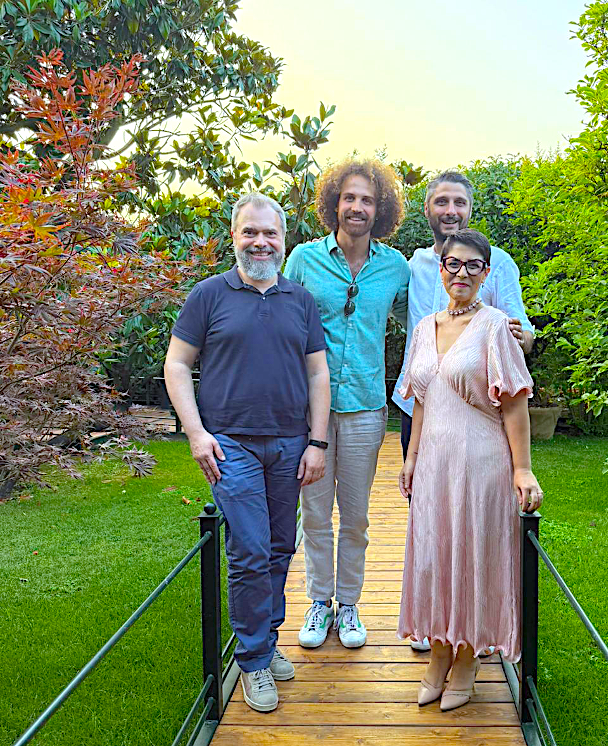
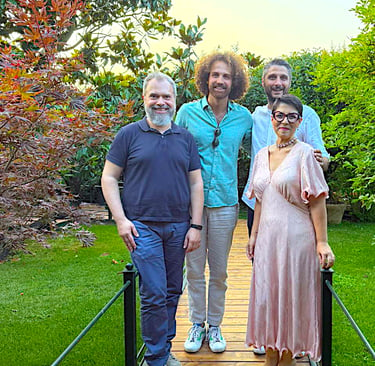
The team includes four members:
Antonella Bellina – CEO and Business Development Director, from whom the idea originated. She spent years proving that industrial agri-food waste could be spun into high-value commercial resources and has successfully started two other businesses: Duedilatte, transforming milk casein waste into textile fabrics and Lilou Pet Couture, for pet lovers.
Stefano Linari - CTO, a nuclear engineer, specialising in nanotechnological electro-spinning, IoT, and complex hardware; he is also CEO of an IoT and cloud platform for manufacturing optimization and the CTO/Founder of a medtech company specializing in neuro-rehabilitation technologies.
Giorgio Iviglia – CSO (Chief Scientific Officer), a biomedical engineer and materials scientist, focused on how synthetic and natural materials interface with human biology. He handles the technical formulation of the advanced macromolecular protein matrices and patches.
Alessandro Manfredi – CFO (Chief Financial Officer) take care of Financial Control. He holds a PhD in Administration, Finance and Control, and is a Tech-Transfer & Startup Acceleration Specialist. He also works for the climate-focused VeniSIA Accelerator in Venice.
Discussing with Antonella Bellina, already at her third company – she tells me that the team makes all the difference for a successful start-up:
“When I started my first company in 2013 I had very little experience. More than 12 years later with my third start-up – I feel I am getting a completely new life. I I have learnt what makes for an effective team and how important the team is in the success of a start-up. We are four team members, the right size I would say - not too small and not too large - and we complement each other’s skills. I have learnt it is important to have not just the technical and science experts but also the business and finance experts early on. While we have different skillsets and complement each other, we all have the passion for science and sustainability in common. Alignment of values is very important in the team. Also we all have known each other for many years, which helps with trust and coordination of efforts. For example I met Stefano in my usual co-working space, when I was working on Duedilatte more than 10 years ago while me and Giorgio met at an Ecomondo tradeshow in Rimini a few years ago [Ecomondo is the main European trade show on sustainability and green, blue and circular economy concepts]. I also met Alessandro at Ca' Foscari University of Venice; he was coordinating the startup group that I was part of with Duedilatte, which ultimately won the prestigious VeniSIA prize. ”
The product and the science are based on sustainability and the circular economy
Legacy water-heavy (circa 80% water) cosmetic formulations are losing their popularity with consumers as they tend to prefer creams and serums that work at deeper skin levels, have more significant and long-lasting results and are safe both for the user and for the environment.
Paradoxically, consumers show heightened interest in natural non-toxic ingredients (1, 2, 3), demanding also “not just post-damage repair but biological prevention” (in the words of Bellina). At the same time they are more experimental on their skin and body, heavily influenced by social media stars on platforms like Instagram and Tik Tok and ready to experiment with new not entirely validated ingredients and technologies (4, 5), which have led to rising rates of skin sensitivity.
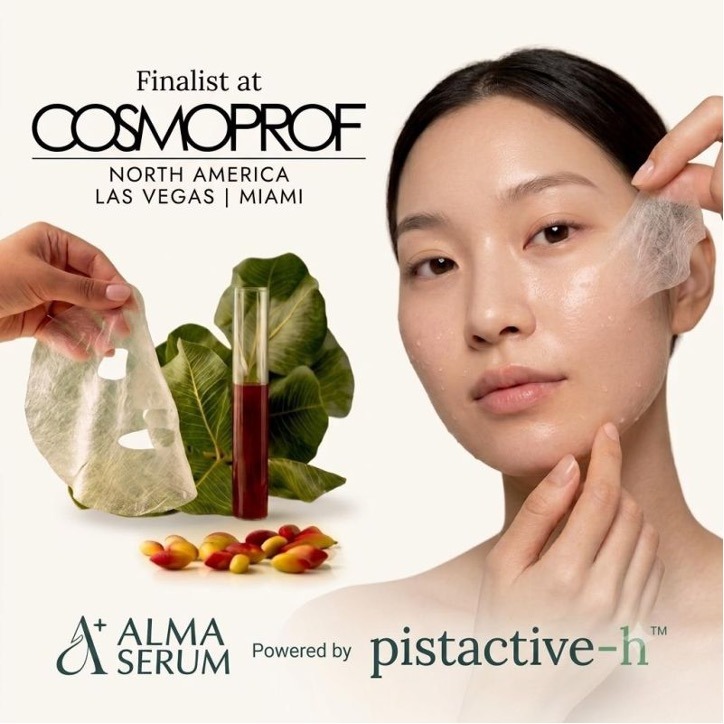
Alma Serum is one of the innovative cosmetics companies that is trying not to compromise on any of those elements. They have a strong eco-friendly and sustainability focus, in fact their first cosmetic product - the "Invisible Shield" (Cleanical Active-Matrix)— is using whey protein from milk, obtained from the waste material resulted in the production process of Parmigiano Reggiano (a staple of Italian culture). This waste material is then used to extract valuable nourishing ingredients and spun them (using a proprietary patented electrospinning machine) into a very concentrated bio-active ingredient. Whey contains substances such as proteins and protein derivatives, sugars with very important prebiotic properties and amino acids. Another key ingredient they use is keratin a protein naturally present in our skin and hair): it is sourced through a patented process that extracts the native protein (meaning whole, non-hydrolyzed keratin) from sheep's wool, certified as cruelty-free. The company is also using other raw ingredients such as pistachios - Pistactive-h being a patented ingredient derived from upcycled Sicilian pistachio hulls, utilised in waterless nanotechnology skin patches to boost collagen and fight oxidative stress.
Alma Serum is delivering waterless product solutions, which replace liquids with advanced solid-state nanofiber matrices that dissolve instantly upon damp skin contact, infusing pure active complexes deeply into the skin, shielding natural homeostasis and triggering endogenous collagen synthesis from within. The products also represent a cellular anti-stress shield and an advanced anti-inflammatory defense for the skin according to the startup founders.
At the moment their products include dissolving face masks and targeted skin and hair patches (smaller, highly concentrated and versatile nanofiber shapes designed to melt onto specific problem areas, such as under the eyes, expression lines or on hair).
“There are no perfumes or essential oils added to the products and they are odorless – in fact then the milk proteins are spun into the electrospinning machine to nanoparticle level, they lose any potential odour they might have had. The products are also preservative-free” says Antonella Bellina, the CEO.
The mask and the patches have undergone both in-vitro (they ran in vitro toxicological screening and cell-viability testing using human cell cultures like keratinocytes and fibroblasts) and in-vivo clinical testing (on 25 volunteers) and no side effects were recorded. They also recorded a 48h visible skin healing effect (tested against skin rashes) outperforming current leading commercial formulations.
Their business model and IP revolve around proprietary technologies and many vertical collaborations in the circular economy
Alma Serum has a couple of patents pending internationally – one product and one process related. The two main industrial stages of their process include filtration and electrospinning. Filtration happens directly as the dairy farm partner sites. The equipment is compact but occupies about 6 – 9 sqm. It extracts the raw proteins and purifies the residual water resulting from the whey processing with the water being returned to the dairy farm for reuse.
The electrospinning is a separate process carried out in their own labs in Pisa – the machine is small, about the size of coffee vending machine. This hardware spins the pure macromolecular protein matrices into the final nanofibers that become their masks and patches.
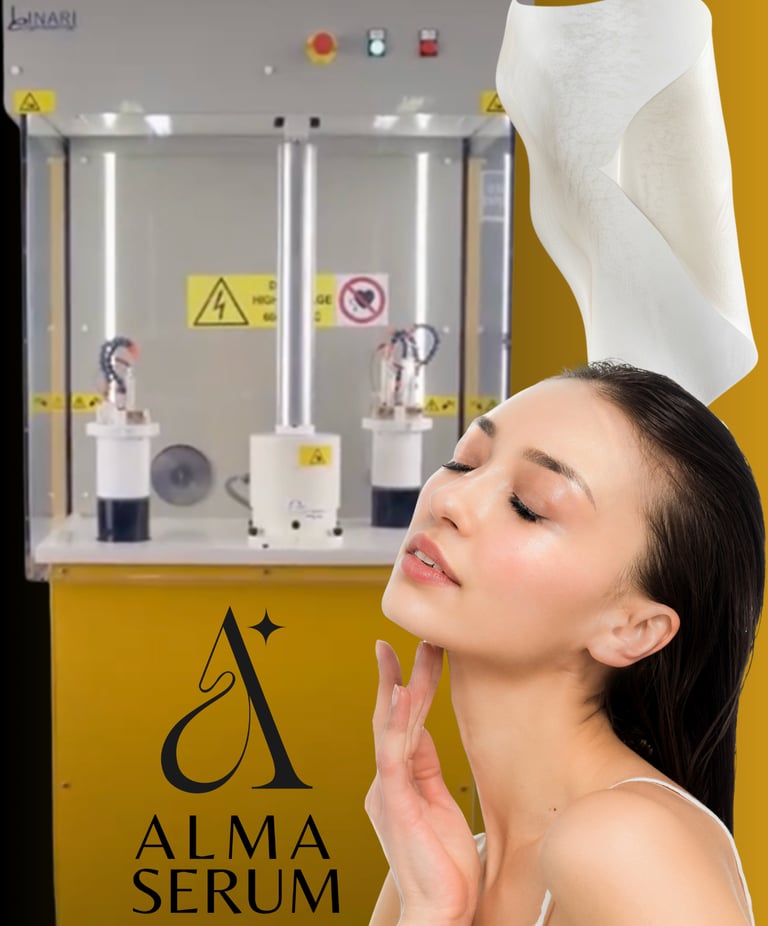
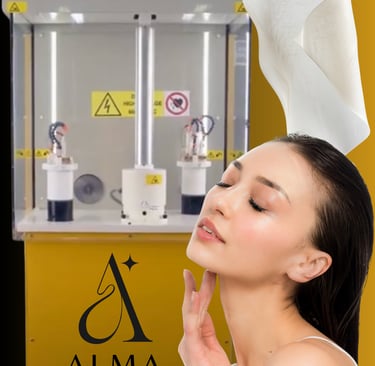
The Alma Serum electrospinning machine and the resulting spun nanofiber matrix used to create the absorbable face masks
The start-up is innovative not only in its product but also in its business model that combines advanced biotechnology, nanotechnologies (MedTech hardware roots) and environmental sustainability for premium cosmetic delivery. A green-chemistry process isolates premium bio-active polymers and proteins from agri-food side streams and waste at zero raw material cost. The electrospinning hardware weaves these complex macromolecules into ultra-pure micro- and nano-structured matrices.
Electrospinning device (generic) - it is mainly composed of an injection pump, a syringe connected with a spinneret, a high-voltage power supply, and a collector
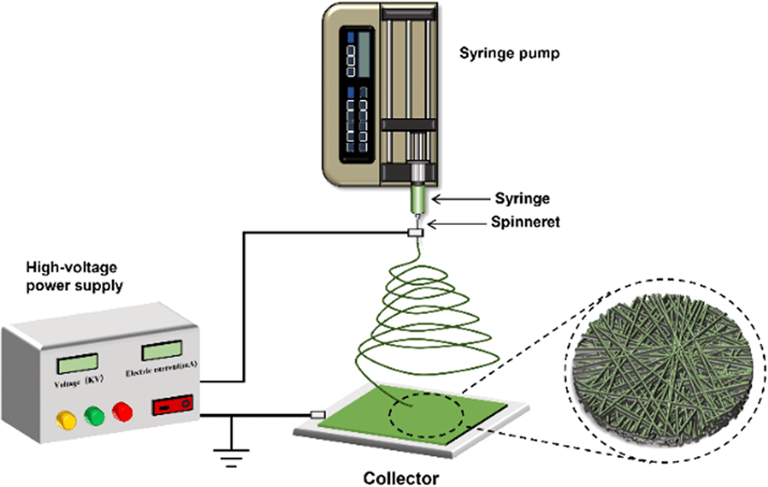
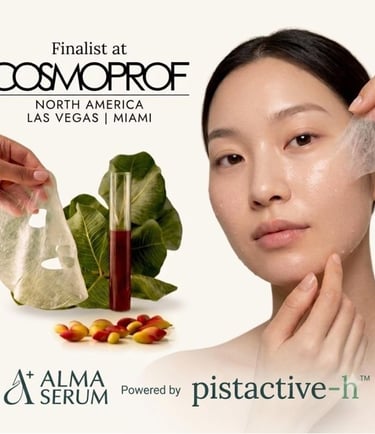
Instead of traditional consumer retail, the company's current phase focuses on presenting its advanced technology at industry-specific exhibitions such as the Milan Longevity Summit or Cosmoprof to establish B2B partnerships.
The sustainability and circularity of the production process is a key principle of the startup: the nanotechnological filtration system they use to filter the milk serum releases cleaned filtered water that can then be immediately re-used in the production cycle of the dairy farm or in agriculture.
The company’s business model focusses on the whole circular economy ecosystem and the integrated supply value chain, building partnerships with the dairy producers (who are both providers of raw materials for Alma Serum and buyers of its proprietary machinery), with established cosmetics and biotech firms and also with pharmacy chains marketing their own branded products.
In a year the startup has received EUR 170k in investment from CDP Ventures, the main investment fund for startups in Italy, backed by the government. Apart from this, it has received early-stage acceleration support from Eatable Adventures through their FoodSeed accelerator network and a non-dilutive grant contribution from LAZIO INNOVA (Lazio Region).
In July the team is travelling to Las Vegas in the US, as one out of four finalists in the 2026 Cosmopack North America Awards in the Best Formulation category, defined by Bellina as “an absolute dream come true, showing that when a startup combines relentless research with uncompromising production and product quality and sustainability, the world takes notice. We are the only innovative startup in the running, alongside global beauty conglomerates.”
The startup established partnerships with large dairy producers of Parmigiano Reggiano such as Lactalis, Igor Gorgonzola and also with Vason Group and ENOLOGIA (specialized partners for oenological and chemical supply processes), that can supply Alma Serum with their main raw materials on a regular basis. Secured 6 signed LOIs in Paris with international beauty brands and 2 active NDAs in Milan with Tier-1 Pharma companies.
There are several lessons learnt and future plans of growth
Bellina says that when she started her first company in 2013 there were not that many educational and financial instruments available to startups in Italy as there are now. One of her main challenges with Duedilatte was starting the company with debt from the bank. She would never do that now and would strongly advise any Italian entrepreneur against it.
She has also never applied for any startup or innovation grants with the first company – which, in the hindsight, was a mistake, she would now advise startup founders to research and apply to relevant grants in their sector and any other adjacent sectors that allow application.
In her first company Bellina only had one other co-founder – they had strong technical and operational knowledge, but little commercial and financial knowledge. Now at Alma Serum she has a larger team, including a variety of complementary skills.
“We were only two co-founders and had challenges with everything from finding good suppliers, negotiating contracts, finding R&D partners …it was a steep learning curve. We had technical knowledge of the process and supply chain experience but none of us had knowledge of finance, BD or commercial and marketing. We thought at the beginning to have our brand of clothing – that was crazy, there are so many competitors.”
The team would like before the end of 2026 to be able to get their seed round to build their own scale-up lab and to increase their production capacity. In 2027 they plan to focus on building the scale-up lab and increase commercial partnerships.
From the end of 2028 – beginning of 2028 more R&D is on the horizon to start developing new plant-based matrices, tapping into the very large and growing vegan cosmetics segment.
“We are developing technologies to recover valuable proteins and resources from food industry by-products, transforming what was once considered waste into high-value ingredients for the future of cosmetics and longevity. We believe that the future of beauty could also help regenerate the planet.”
The team is also very confident in the potential of their products for the Biotech and Healthcare industry and will be looking at this in the future. Bellina says “our delivery system has been proven to be very efficient – we run some tests in collaboration with the University of Bologna, delivering an antimycotic bioactive ingredient applied directly to the skin and we saw that in six days the fungus completely disappeared”.
There market seems ripe with opportunities for Alma Serum – in the cosmetics field consumer demand is shifting towards non-toxic yet potent active ingredients; secondly, due to visible effects of climate change, pollution and energy and waste costs, environmental sustainability and the circular economy are set to come back to the forefront of government agendas – at least in Europe; finally, there is recent research indicating the potential for electrospun nanofibers as multifunctional wound and burn dressings (6) in healthcare. Companies that can offer clean, chemical-free, effective, sustainable and circular products are going to be the winners of tomorrow.
Some sources:
Interview with Antonella Bellina, the CEO
(1) https://ttconsultants.com/top-10-trends-shaping-cruelty-free-cosmetics-in-2024/
(3) https://www.rangeme.com/blog/clean-beauty-products-are-quickly-gaining-a-new-consumer-base/
(4) https://www.sciencedirect.com/science/article/pii/S0001691825010479
(5) https://www.youtube.com/watch?v=ZPhKlZuh58c
(6) https://pubs.rsc.org/ra/article/14/20/14374/865610/Recent-progress-of-electrospun-nanofibers-as
IGEA Healthcare
Strategic Advisory for Life Sciences
Switzerland, UK, Italy
contact@igeahealthcare.com
© 2025 - 2026. All rights reserved.